Written by Stephen Njenga
Based on research into Nairobi water quality, hard-water exposure, skin-barrier function and hyperpigmentation in darker skin tones. Educational content only — not a substitute for professional medical advice.
Moving into a new apartment or estate in Nairobi can sometimes bring an unexpected skincare challenge. You may notice that your skin feels drier than usual, becomes tight after washing, looks dull, or seems more easily irritated.
If your skincare routine has suddenly stopped feeling as comfortable as it used to, your water supply may be one factor worth investigating.
Water hardness varies between water sources, and recent research examining water quality in Nairobi County has found measurable differences in calcium, magnesium, alkalinity and total hardness between water sources, including borehole and tap water.
But what does that mean for your skin?
Hard water does not automatically mean that your skin will become damaged, and it would be too strong to claim that hard water directly causes acne or dark spots. However, research suggests that hard water can interact with cleansing products in ways that increase surfactant residue on the skin, potentially contributing to irritation and barrier disruption. Other population-level research has also found an association between harder residential water and dry skin.
For skin that is prone to post-inflammatory hyperpigmentation (PIH), repeated irritation is particularly worth paying attention to because inflammation can contribute to persistent discoloration.
Let’s break down what the science actually tells us — and what you can realistically do about it.
The Science: What Exactly Is Hard Water?
Water hardness is primarily determined by the concentration of dissolved minerals, especially calcium and magnesium ions.
These minerals can enter groundwater as water moves through geological formations and can vary considerably between different water sources.
Nairobi’s water sources are not chemically identical. A recent study examining tap, borehole, bottled and river water in Nairobi County measured parameters including calcium, magnesium and total hardness and found significant differences between sources. In that study, borehole and river water generally showed higher hardness-related measurements than tap and bottled water.
That does not mean every borehole in Nairobi is hard or that every tap-water supply is soft. Your individual supply can differ depending on its source and treatment.
That’s why testing your actual household water is more useful than assuming your estate’s water has a particular hardness level.
What Happens When Hard Water Meets Your Cleanser?
This is where the science becomes particularly interesting.
Your cleanser contains ingredients called surfactants that help lift oil, dirt and other substances from the skin so they can be rinsed away.
Research has found that water hardness can affect what remains on the skin after washing.
In a controlled study involving 80 participants, including healthy controls and people with atopic dermatitis, researchers compared washing with water of different hardness levels. They found that sites washed with hard water had significantly greater deposition of sodium lauryl sulfate (SLS), a cleansing surfactant. These deposits were associated with increased transepidermal water loss (TEWL) and irritation, particularly in participants with atopic dermatitis carrying certain FLG mutations. Water softening reduced the surfactant deposition.
Another study examining different cleansing products found that hard-water washing conditions were associated with greater dryness, redness and lower skin hydration compared with deionized water.
So the important point isn’t that calcium crystals are literally scratching your skin.
The more defensible explanation is:
Hard water + certain cleansing products
↓
Greater surfactant/soap residue after washing
↓
Greater potential for irritation and barrier disruption
↓
Dryness + increased water loss from the skin
The effect is influenced by the cleanser, the water hardness, the frequency of washing and the condition of your skin.
Why Does the Skin Barrier Matter?
The outermost layer of your skin, the stratum corneum, acts as an important protective barrier.
Think of it as a carefully organized structure made up of skin cells surrounded by lipids. Among the important lipids involved in this barrier are ceramides, cholesterol and free fatty acids.
When the barrier is functioning well, it helps regulate water loss and protects the skin from external irritants.
Harsh cleansing can interfere with this system. Research on skin-cleansing products shows that some surfactants can interact with and remove components of the stratum corneum, contributing to dryness and barrier disruption.
This is why your response to hard water may not be as simple as:
“The minerals are drying my skin.”
A more useful way to think about it is:
Water hardness + cleanser + washing habits + your individual skin sensitivity
can all influence how your skin feels after cleansing.
What About Melanin-Rich Skin and Dark Spots?
This is where the conversation becomes particularly relevant for Melanin Theory.
Hard water itself has not been established as a direct cause of hyperpigmentation.
However, irritation and inflammation are important contributors to post-inflammatory hyperpigmentation (PIH), especially in darker skin tones.
A review of PIH in dark skin explains that inflammatory stressors such as injury, allergic reactions and UV exposure can interact with the biology of darker skin and contribute to discoloration. Prolonged inflammatory responses can influence melanogenesis and the persistence of pigmentation.
So the more scientifically accurate chain is:
Hard water / cleansing conditions
↓
Potential irritation or barrier disruption
↓
Inflammation in susceptible skin
↓
Greater risk of persistent discoloration if PIH develops
This is different from saying that hard water directly “creates dark spots.”
That distinction matters.
Your skin may be more vulnerable to visible consequences of inflammation, but that doesn’t mean everyone with melanin-rich skin will react to hard water in the same way.
Does Nairobi’s Water Actually Vary?
Yes.
Water quality can differ according to the source supplying a property.
A recent study of water sources across Nairobi County measured tap, borehole, bottled and river water and found significant differences in several physicochemical parameters, including calcium, magnesium and total hardness. Borehole water showed higher total alkalinity and hardness-related measurements than some of the other sources examined.
However, this does not allow us to say:
“Estate X has bad water.”
Nor does it mean:
“All Nairobi borehole water is hard.”
Water chemistry can vary from one source to another.
So how can you know?
Test your water.
A household water-hardness test can give you a much better indication of what is coming out of your own tap than guessing based on your estate or neighborhood.
Visible white deposits around kettles, taps or showerheads can also suggest mineral-rich water, but they are not a substitute for an actual hardness measurement.
The 3-Step Hard-Water Skin Strategy
You don’t necessarily need to stop using your tap water.
Instead, start by reducing unnecessary irritation and supporting your skin barrier.
Step 1: Choose a Gentle Cleanser
If your skin feels tight, dry or irritated after washing, reconsider the cleanser before blaming the water alone.
Avoid relying on harsh alkaline soaps or aggressive cleansing routines, especially if your skin is already dry or sensitive.
Instead, consider a gentle, soap-free cleanser designed to minimize disruption of the skin barrier.
Look for products that are:
- Gentle and non-stripping
- Suitable for your skin type
- Free from unnecessary irritants
- Formulated to cleanse without leaving your skin feeling tight
A low-foam cleanser can be a reasonable option, but foam itself does not determine whether a cleanser is damaging. The surfactant system and overall formulation matter.
Research comparing cleansing systems shows that soap-based products can be more disruptive to the skin barrier than appropriately formulated syndet cleansers.
Examples to investigate
CeraVe Hydrating Facial Cleanser
A lotion-type cleanser containing ceramides and humectant ingredients.
Cetaphil Gentle Skin Cleanser
A mild, soap-free cleansing option designed for gentle cleansing.
These are examples, not prescriptions. The best cleanser is the one your skin tolerates well.
Step 2: Support the Skin Barrier
If your skin is persistently dry or irritated, focus on barrier-supportive moisturization.
Look for formulations containing combinations of ingredients such as:
- Ceramides
- Cholesterol
- Fatty acids
- Glycerin
- Petrolatum or other occlusive ingredients
- Other well-tolerated emollients
Ceramides, cholesterol and free fatty acids are important components of the stratum-corneum lipid matrix. Research has also investigated optimized mixtures of these physiological lipids for improving barrier recovery.
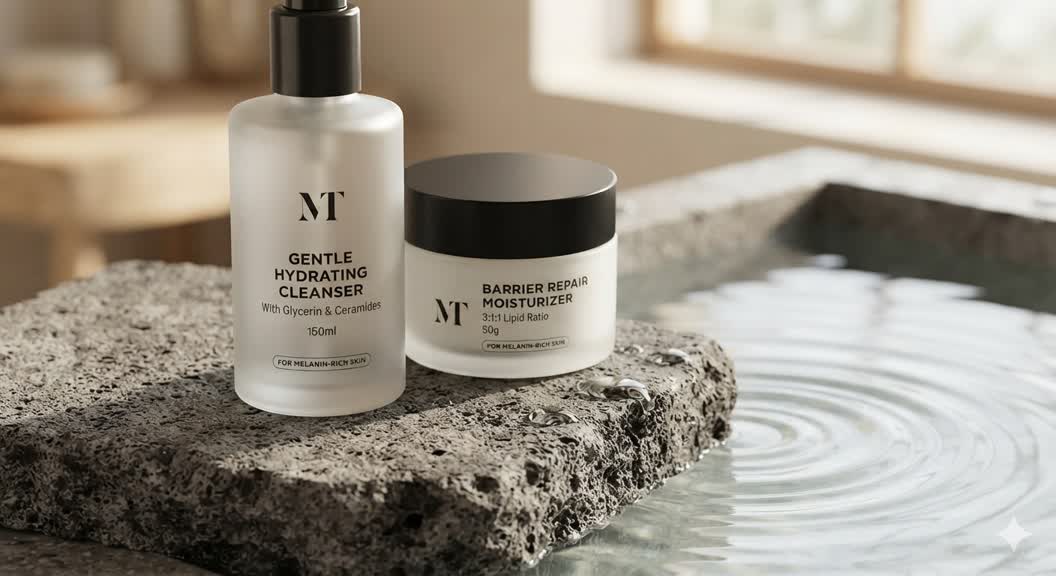
You may see skincare products marketed around a 3:1:1 lipid ratio.
However, don’t treat 3:1:1 as a magic formula that every moisturizer must contain. Research has examined several lipid ratios and formulations, and the outcome depends on the specific ingredients and formulation.
The practical lesson is simpler:
Look for a well-formulated moisturizer that supports the skin barrier rather than chasing one specific ratio.
Examples to investigate
La Roche-Posay Cicaplast Baume B5+
A balm formulated with ingredients including panthenol and madecassoside and commonly used to support irritated skin.
Bioderma Atoderm Intensive Baume
A richer moisturizer designed for dry and sensitive skin.
Again, these are examples rather than individualized medical recommendations.
Step 3: Experiment With Your Rinse
If you strongly suspect that your household water is contributing to facial dryness or irritation, you can perform a simple personal experiment.
For several days, keep the rest of your skincare routine consistent.
After cleansing, try using a small amount of clean, low-mineral drinking water as a final rinse.
Then moisturize as usual.
If your skin consistently feels more comfortable, that may be a useful clue that your water or cleansing conditions are contributing to the problem.
But remember:
This is a practical experiment, not a proven treatment for hard-water-related skin problems.
You do not need to wipe your face with micellar water after every wash, and there is no good evidence that calcium crystals “settle deep into your pores” when tap water dries on your skin.
If your skin is reacting strongly, the better approach is to investigate the cleanser, water hardness and other environmental factors rather than continually adding more products.
What About Acne and Dark Spots?
This is where we need to be careful.
Hard water should not be presented as a proven direct cause of acne.
Acne has many contributing factors, including sebum production, follicular plugging, inflammation, hormones and the skin microbiome.
However, if washing conditions repeatedly irritate your skin, that irritation may make an existing skin problem harder to manage.
And if you are prone to PIH, repeated inflammation can contribute to persistent dark marks.
So if you’re experiencing:
Acne → inflammation → dark mark → new acne → another dark mark
the goal isn’t simply to “wash harder.”
It’s to:
- Manage the underlying acne.
- Reduce unnecessary irritation.
- Support the skin barrier.
- Protect against UV exposure.
- Treat existing pigmentation appropriately.
That is a much more useful approach than blaming one environmental factor for everything.
Don’t Forget Sunscreen
If you’re trying to manage dark spots, daily photoprotection still matters.
UV exposure can contribute to pigmentation, and broad-spectrum sunscreen is an important part of managing hyperpigmentation.
For everyday use, look for a broad-spectrum SPF 30 or higher and apply enough to adequately cover exposed skin.
If pigmentation is your primary concern, a tinted sunscreen containing iron oxides may be worth considering because visible light can also contribute to pigmentation in some people with darker skin tones.
Hard water doesn’t replace the need for sun protection — and sunscreen doesn’t replace the need to manage irritation.
They address different parts of the problem.
Has Nairobi’s Hard Water Been Affecting Your Skin?
Don’t immediately replace your entire skincare collection.
First, ask better questions:
Is my water actually hard?
Is my cleanser irritating my skin?
Does my skin feel tight immediately after washing?
Have I recently changed my water source?
Am I experiencing dryness, acne, irritation or pigmentation — or a combination of these?
Am I using enough moisturizer and sun protection?
Understanding those factors can help you build a routine based on your actual skin rather than internet trends.
Want help figuring out your skin profile?
Take the Melanin Theory Skin Analyzer to identify your skin type, concerns and potential routine priorities.
Summary Checklist: Managing Possible Hard-Water Skin Issues
💧 Test
If you suspect hard water, test your household water rather than assuming.
🧼 Cleanse gently
Choose a mild, soap-free cleanser if your current cleanser leaves your skin tight or irritated.
🧴 Support the barrier
Look for moisturizers containing barrier-supportive ingredients such as ceramides, cholesterol and fatty acids.
🚿 Experiment
If you suspect your water is contributing to irritation, try a clean-water final rinse for a few days while keeping the rest of your routine consistent.
☀️ Protect
Use broad-spectrum SPF 30+ regularly, particularly if you are managing hyperpigmentation.
🧪 Don’t blame one factor
Hard water may be one piece of the puzzle. Your cleanser, skincare products, climate, acne, UV exposure and individual skin sensitivity can all matter.
Scientific References
1. Danby SG, Brown K, Wigley AM, et al. (2018).
The Effect of Water Hardness on Surfactant Deposition after Washing and Subsequent Skin Irritation in Atopic Dermatitis Patients and Healthy Control Subjects.
Journal of Investigative Dermatology, 138(1), 68–77.
PMID: 28927888.
DOI: 10.1016/j.jid.2017.08.037.
The study included healthy controls as well as participants with atopic dermatitis and found greater SLS deposition after washing with hard water, with associated increases in TEWL and irritation.
2. Henning MAS, Ibler KS, Ullum H, et al. (2021).
The association between water hardness and xerosis — Results from the Danish Blood Donor Study.
PLOS ONE, 16(6), e0252462.
PMID: 34077478.
The study examined 30,721 adult blood donors and found that harder residential water was associated with increased probability of xerosis; the association remained after excluding participants with dermatitis.
3. Idowu OC, Mammone T. et al. (2022).
Post-Inflammatory Hyperpigmentation in Dark Skin: Molecular Mechanism and Skincare Implications.
International Journal of Molecular Sciences.
PMID: 36466945.
This review discusses how inflammatory stressors can contribute to pigmentation and discoloration in darker skin.
4. Kuehl BL, Shear NH, et al.
The influence of hard water (calcium) and surfactants on irritant contact dermatitis.
Research examining cleansing under different water-hardness conditions found increased dryness, redness and reduced hydration under hard-water washing conditions.
5. Man MQ, Feingold KR, Thornfeldt CR, Elias PM.
Optimization of physiological lipid mixtures for barrier repair.
Journal of Investigative Dermatology.
The research demonstrates the importance of physiological stratum-corneum lipids, including ceramides, cholesterol and fatty acids, in barrier recovery.