
Author: Stephen

  • Why Your Dark Spots Aren’t Fading: The 3 Silent Saboteurs and the Melanin-Safe Fix

    Why Your Dark Spots Aren’t Fading: The 3 Silent Saboteurs and the Melanin-Safe Fix


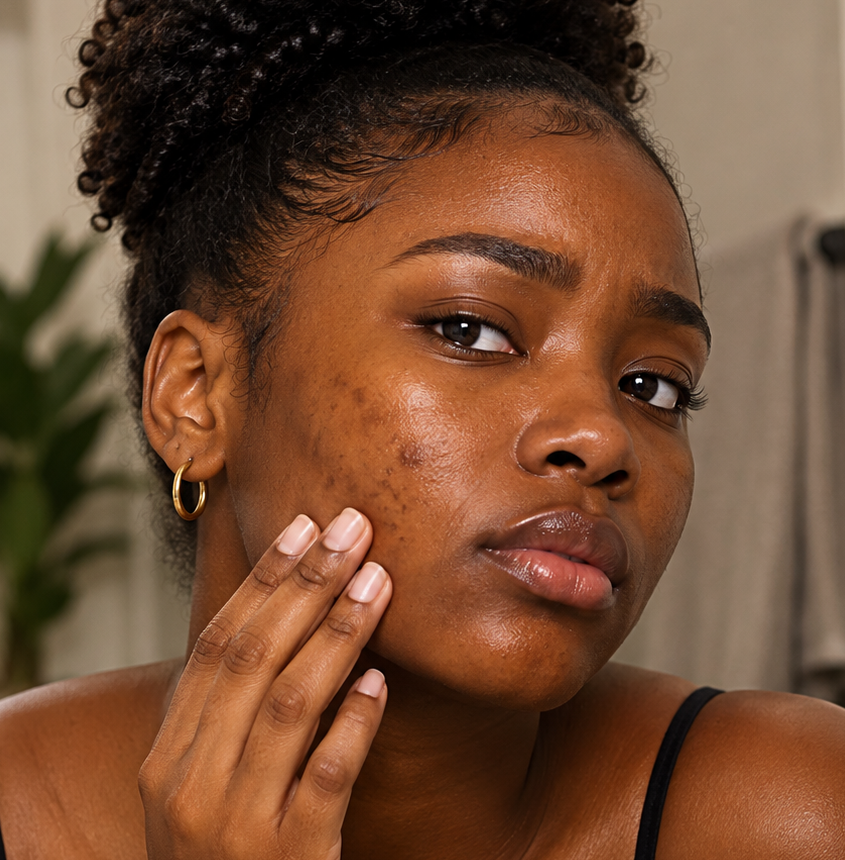
    We have all been there. A painful pimple appears on your cheek or jawline. You treat it, it heals, and you breathe a sigh of relief — only to find a stubborn dark purple or brown spot left in its place.

    Weeks turn into months. You buy expensive serums, try viral skincare hacks from TikTok, maybe even reach for a harsh scrub to “wash” the mark away. But the spot stays put. Or worse, it seems to get darker.

    If you are struggling with dark spots from acne not fading, hiding under concealer, or feeling frustrated every time you look in the mirror, hear this: it is not your fault, and your skin is not broken.

    The truth is, most standard skincare advice ignores how hyperpigmentation on melanin-rich skin actually works. By treating your dark spots the wrong way, you may be accidentally forcing them to stay.

    Let’s unpack the science, expose the three mistakes sabotaging your progress, and walk through a simple, melanin-safe skincare routine that clears your skin for good.

    The Secret Biology of Melanin-Rich Skin

    To fix the problem, you have to understand why it happens.

    Inside your skin are specialized cells called melanocytes. Think of them as tiny, hyper-protective security guards. Their entire job is to produce melanin — pigment — to shield your skin from danger, like harsh UV rays or physical damage.

    When your skin experiences trauma — an acne breakout, an insect bite, a scratch, a harsh chemical burn — these guards panic. They rush to the site of injury and overproduce pigment as a protective shield.

    This reaction is called Post-Inflammatory Hyperpigmentation (PIH) — the clinical name for what you and I call dark spots.

    Because melanin-rich skin naturally has highly active, highly responsive melanocytes, our security guards are incredibly sensitive. Minor irritation sets them off. This means the dark spot is not a scar — it is an over-accumulation of pigment caused by a stressed-out skin barrier.

    The 3 Silent Saboteurs Blocking Your Progress

    The American Academy of Dermatology confirms that a spot a few shades darker than your natural skin color will usually fade within 6 to 12 months, but if the pigment lies deep in your skin, fading can take years. This is why treating PIH on dark skin correctly from the start matters so much.

    Most people treat dark spots by going to war with their skin. But when you fight your melanin, your melanin fights back. If your spots aren’t fading, you are likely caught in one of these three traps.

    Saboteur 1: Trying to “Scrub” the Spot Away

    When a dark spot appears, it feels intuitive to want to exfoliate it off. You reach for a gritty apricot scrub, a harsh facial brush, or layer high percentages of glycolic and salicylic acids all at once.

    Why this fails: Your pigment cells respond to irritation. Aggressive scrubbing strips your protective skin barrier and triggers inflammation. Your melanocytes read this as a physical attack and produce more melanin to defend themselves. Dermatology research confirms that treatment of post-inflammatory hyperpigmentation “should be started early to help hasten its resolution and begins with management of the initial inflammatory condition.” All treatments must be used cautiously “to prevent irritation and worsening of PIH.” You are not washing the spot away — you are telling your skin to hold onto it longer.

    Saboteur 2: Skipping Sunscreen on Cloudy or Dusty Days

    There is a dangerous myth in Kenya that dark skin does not need sunscreen, or that you only need it if you are spending the day at the beach in Mombasa.

    Why this fails: Nairobi sits on the equator at high altitude, and its UV rays pierce straight through clouds, pollution, and morning mist. Even sitting indoors near a window, UVA rays reach your skin.

    The American Academy of Dermatology specifically warns that “the darker your skin tone, the higher your risk that UV rays and visible light from the sun will cause dark spots.” Research presented at the AAD confirms that “visible light can independently induce and perpetuate hyperpigmentation, especially in skin of color.” This is why dermatologists recommend tinted sunscreen with iron oxide for melanin-rich skin — iron oxide blocks visible light, not just UV.

    When UV and visible light hit an existing dark spot, they act like fuel on a fire. They reactivate the pigment engine, darkening the exact spots you are trying to fade with your serums. Without daily sunscreen, even the best serum for dark spots in Kenya is wasted money.

    Saboteur 3: Treating the Spot While Ignoring the Acne

    This is the most common trap of all. You are spending thousands of shillings on fading creams, but you haven’t addressed the root cause of your breakouts.

    Why this fails: Every new pimple is a future dark spot waiting to happen. The American Academy of Dermatology states directly: “To get rid of hyperpigmentation caused by a skin condition, you must effectively treat the skin condition first. When the breakouts or flare-ups stop, you get rid of what’s causing the hyperpigmentation.”

    A review in the Journal of Clinical and Aesthetic Dermatology confirms: “The treatment of postinflammatory hyperpigmentation should be started early to help hasten its resolution and begins with management of the initial inflammatory condition.”

    If you pour all your energy into fading old marks while letting new breakouts run wild, your skin will never fully clear. You are running on a skincare hamster wheel — fading yesterday’s spots while creating tomorrow’s.

    The fix is not more fading products. It is calming the active breakouts and lowering overall skin inflammation first. Once new breakouts stop, your fading products finally have room to work. Without this step, everything else is damage control.

    The Melanin-Safe Solution: The “Calm, Block, Fade” Framework

    To fade hyperpigmentation safely without damaging your skin tone, drop the aggressive treatments and adopt this gentle, three-step approach.

    1. CALM — Protect the Barrier

    Before introducing any strong brightening ingredients, you must signal to your security guard cells that the danger has passed. Flood your skin with soothing, anti-inflammatory ingredients that repair the skin barrier.

    Look for: Centella Asiatica (Cica), Niacinamide, or nourishing local plant botanicals.

    When the barrier is calm and hydrated, pigment production naturally slows down.

    1. BLOCK — The Daily Shield

    Wear a broad-spectrum SPF 30 or SPF 50 sunscreen every single morning as the final step of your routine. For melanin-rich skin, tinted sunscreen with iron oxide is ideal because it blocks visible light, which research shows can worsen hyperpigmentation in skin of color.

    Sunscreen acts as a physical wall, blocking UV and visible light from activating your pigment cells. This allows your skin’s natural renewal process to lift old, dark pigment to the surface and shed it — without new pigment taking its place.

    1. FADE — The Gentle Brighteners

    Instead of unregulated bleaching creams and steroid-based mixes — which can cause permanent damage and patchy discoloration — use gentle tyrosinase inhibitors. These are smart ingredients that regulate the enzyme responsible for pigment production, without altering your natural skin tone.

    Excellent, melanin-safe options:

    Azelaic Acid — A clinical review found that in patients with melasma, “azelaic acid proved at least as effective as topical hydroquinone.” It calms active acne and fades the red or dark marks left behind.

    Alpha Arbutin — A randomized controlled trial published in the Journal of Dermatology found that “a significant response was obtained from all of 10 patients who used arbutin,” with a statistically significant decrease in melanin levels after treatment. It is a gentle, stable derivative of hydroquinone that brightens dark patches safely.

    Kojic Acid / Licorice Root Extract — Research confirms kojic acid has “clinically effective anti-melanogenic activity on hyper-pigmented skin.” These are natural, effective antioxidants that target localized discoloration.

    Stop Guessing. Let’s Build Your Custom Routine.

    Skincare is never one-size-fits-all. An ingredient that works wonders for someone with dry skin might trigger massive breakouts if you have oily skin living in a dusty, hot environment.

    You do not need a confusing 10-step routine or luxury price tags to achieve radiant, even-toned skin. You just need a routine that understands your unique skin biology and your daily environment.

    We built a free, intelligent tool to take the guesswork out of your hands. Take our quick quiz to identify your exact skin profile and get a personalized, science-backed skincare routine for hyperpigmentation in Nairobi.


    References

    1. American Academy of Dermatology. “Post-inflammatory hyperpigmentation: Diagnosis and treatment.” AAD.org.
    2. Davis EC, Callender VD. “Postinflammatory hyperpigmentation: a review of the epidemiology, clinical features, and treatment options in skin of color.” Journal of Clinical and Aesthetic Dermatology. 2010.
    3. American Academy of Dermatology. “Melasma: Diagnosis and treatment.” AAD.org.
    4. American Academy of Dermatology ePoster. “Visible Light and Hyperpigmentation in Skin of Color.” 2023.
    5. Fitton A, Goa KL. “Azelaic acid: A review of its pharmacological properties and therapeutic efficacy in acne and hyperpigmentary skin disorders.” Drugs. 1991.
    6. Nakayama K, et al. “Arbutin: Mechanism of its depigmenting action in human melanocyte culture.” Journal of Dermatology.
    7. Lee YS, et al. “Kojic acid dipalmitate: Inhibitory effects on melanin production.” Journal of Dermatological Science. 2012.


  • Melanin Explained: Understanding the Science behind Dark Skin

    Melanin Explained: Understanding the Science behind Dark Skin

    Understanding the Biology Behind Your Skin

    Human skin exists in a remarkable spectrum of colors, and one of the most important biological factors responsible for this diversity is melanin.

    For generations, many skincare conversations have focused on correcting skin concerns without first understanding the science behind different skin types. This has created confusion, myths, and sometimes harmful approaches to skincare.

    The truth is that melanin is not a problem to fix. It is a biological feature to understand.

    Melanin influences skin color, how our skin responds to sunlight, how pigmentation changes occur, and why certain concerns — such as dark spots and uneven skin tone — are more noticeable in some people with melanin-rich skin.

    At Melanin Theory, we believe that better skincare begins with better understanding.

    In this article, we will explore what melanin is, how the body produces it, why darker skin contains more pigment, and how understanding melanin can help you make better skincare decisions.

    What Is Melanin?

    Melanin is a natural pigment produced by specialized cells in the skin called melanocytes.

    It is responsible for the color of:

    Skin

    Hair

    Eyes

    The amount, type, and distribution of melanin determine the natural pigmentation of an individual’s skin.

    However, melanin is more than just a pigment that gives skin its color. It is part of a complex biological system involved in protecting the skin from environmental stress, especially ultraviolet (UV) radiation from the sun.

    Inside the skin, melanin is produced and stored in tiny structures called melanosomes. These structures transport pigment from melanocytes to surrounding skin cells, where it contributes to visible skin color.

    The process can be summarized as:

    Melanocytes → Produce melanin → Store melanin in melanosomes → Transfer pigment to skin cells → Visible skin pigmentation

    The Role of Melanocytes: Your Skin’s Pigment-Producing Cells

    Melanocytes are specialized cells located in the deepest layer of the epidermis, the outermost layer of the skin.

    Their primary function is to produce melanin through a process known as melanogenesis.

    When the skin is exposed to factors such as ultraviolet radiation, melanocytes can increase melanin production as part of the body’s natural response.

    The process involves several important steps:

    1. The amino acid tyrosine is converted through biological reactions.

    2. The enzyme tyrosinase plays an important role in melanin production.

    3. Melanin is packaged inside structures called melanosomes.

    4. Melanosomes transfer pigment to surrounding skin cells.

    This biological process determines how much pigment is produced and how it appears on the skin.

    Melanosomes: Understanding the Difference Between Skin Tones

    A common misconception is that people with darker skin have significantly more melanocytes.

    This is not accurate.

    Most humans have a similar number of melanocytes. The differences between lighter and darker skin tones are mainly due to differences in:

    The amount of melanin produced

    The size of melanosomes

    The amount of pigment stored

    How long melanosomes remain active within skin cells

    People with darker skin generally have larger melanosomes containing more eumelanin, and these melanosomes remain distributed within skin cells for longer periods.

    This contributes to deeper skin pigmentation.

    The Two Main Types of Melanin

    Humans produce two main types of melanin:

    1. Eumelanin

    Eumelanin is the pigment responsible for brown and black coloration.

    It is commonly associated with:

    Darker skin tones

    Brown eyes

    Dark hair

    Eumelanin has the ability to absorb and scatter some ultraviolet radiation, contributing to the skin’s natural defense system.

    2. Pheomelanin

    Pheomelanin produces yellow to reddish pigmentation.

    It is associated with:

    Lighter pigmentation

    Red or lighter hair characteristics

    Most individuals have a combination of both eumelanin and pheomelanin, but the balance between them differs from person to person.

    Why Does Dark Skin Have More Melanin?

    The variation in human skin color developed through thousands of years of human adaptation.

    Populations living in areas with higher levels of ultraviolet radiation, particularly regions closer to the equator, developed higher levels of eumelanin as an adaptation to intense sunlight exposure.

    Melanin helps absorb and scatter some UV radiation, reducing the impact of sunlight on skin cells.

    However, an important point must be understood:

    Melanin provides natural protection, but it does not make the skin immune to sun damage.

    People with darker skin can still experience:

    Sun-related aging

    Hyperpigmentation

    Uneven skin tone

    Skin damage caused by UV exposure

    This is why sun protection remains important for every skin tone.

    How Melanin Influences Skin Health

    Melanin affects several aspects of how skin behaves.

    Melanin and Sun Protection

    One of melanin’s important biological roles is helping protect skin cells from ultraviolet radiation.

    Higher levels of melanin can provide some natural protection, but this protection is limited.

    Sunscreen remains an important part of maintaining healthy skin because UV radiation can affect everyone.

    Melanin and Aging

    Melanin-rich skin often experiences visible aging differently compared to lighter skin tones.

    Some studies suggest that higher melanin levels may provide some protection against certain aspects of photoaging caused by UV exposure.

    However, darker skin still experiences natural aging processes, including:

    Reduced collagen production

    Changes in skin elasticity

    Changes in skin texture

    Healthy aging requires proper skincare regardless of skin tone.

    Why Melanin-Rich Skin Is More Prone to Hyperpigmentation

    One of the most important skincare topics connected to melanin is hyperpigmentation.

    Hyperpigmentation occurs when certain areas of skin produce or retain more pigment than surrounding areas.

    This can happen due to:

    Acne inflammation

    Skin injuries

    Irritation

    Hormonal changes

    UV exposure

    In melanin-rich skin, pigment-producing cells can respond strongly after inflammation, which may cause dark marks to remain visible for longer.

    Common concerns include:

    Acne marks

    Dark spots

    Uneven skin tone

    Post-inflammatory hyperpigmentation

    Understanding this helps explain why gentle skincare and proper treatment approaches are important.

    Common Myths About Melanin

    Myth 1: Dark Skin Does Not Need Sunscreen

    Reality:

    Melanin provides some natural UV protection, but it does not block all ultraviolet radiation.

    Sunscreen helps protect against:

    UV-related skin damage

    Premature aging

    Pigmentation changes

    Myth 2: Dark Skin Does Not Age

    Reality:

    All skin ages.

    However, signs of aging may appear differently depending on genetics, environment, lifestyle, and skin biology.

    Myth 3: More Melanin Means Perfect Skin

    Reality:

    Melanin affects pigmentation, but it does not prevent all skin concerns.

    Melanin-rich skin can still experience:

    Acne

    Dryness

    Sensitivity

    Irritation

    Inflammation

    Healthy skin depends on many factors beyond pigmentation.

    What Does Melanin-Rich Skin Need From Skincare?

    The goal of skincare should not be changing your natural skin color.

    The goal should be supporting healthy, balanced skin.

    Important principles include:

    1. Protect Your Skin Barrier

    A healthy skin barrier helps maintain:

    Moisture balance

    Protection from irritants

    Overall skin comfort

    2. Understand Ingredients

    Certain skincare ingredients have been studied for concerns related to uneven skin tone and pigmentation, including:

    Niacinamide

    Vitamin C

    Azelaic acid

    Retinoids

    However, skincare should always be personalized because different skin types respond differently.

    3. Practice Sun Protection

    Sun protection remains one of the most important steps in maintaining healthy skin.

    The Melanin Theory Perspective

    At Melanin Theory, we believe skincare begins with knowledge.

    Your skin is not something that needs to be changed to fit a standard.

    Your skin is a biological system with its own characteristics, needs, and strengths.

    Melanin represents human adaptation, diversity, and protection. Understanding how it works allows us to make smarter decisions about:

    Skincare ingredients

    Products

    Daily routines

    Skin health

    The future of skincare is not about chasing unrealistic ideals.

    It is about personalized, science-based care.

    Key Takeaways

    Melanin is a natural pigment responsible for skin, hair, and eye color.

    Melanocytes produce melanin and package it inside melanosomes.

    Differences in skin tone are mainly caused by differences in melanin production and distribution.

    Melanin provides some natural protection against UV radiation but does not replace sunscreen.

    Melanin-rich skin may experience noticeable pigmentation changes after inflammation.

    Understanding your skin biology is the foundation of better skincare.