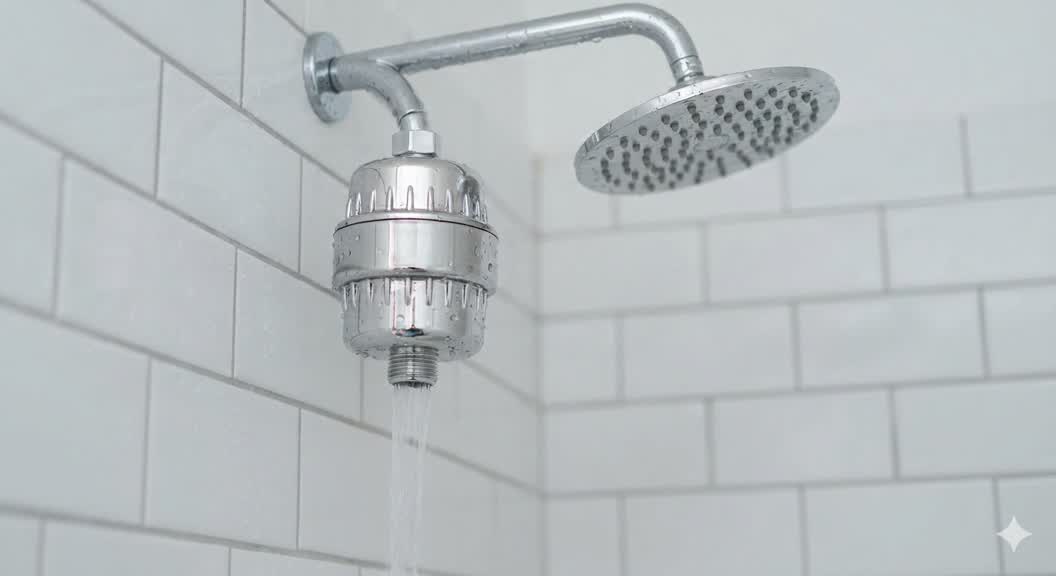
If you use borehole water in Kenya, you may have noticed something after showering: your skin feels tight, dry or uncomfortable, your soap behaves differently, or white mineral deposits appear around taps and shower fittings.
That naturally raises an important question:
Would a shower filter solve the problem?
The answer is more complicated than many product advertisements suggest.
A shower filter can reduce certain substances in water, but a standard shower filter is not necessarily a water softener. And if the problem you’re trying to solve is water hardness, buying a filter simply because it is marketed as a “hard-water shower filter” may not address the underlying issue.
Let’s separate what is actually known from what is often claimed online.
First: What Makes Borehole Water “Hard”?
Water hardness mainly refers to dissolved minerals, particularly calcium and magnesium.
Groundwater can acquire these minerals as it moves through rocks and soil. The amount varies considerably depending on the local geology and the individual water source.
Hard water is not automatically unsafe for bathing. But hardness can affect how soap and cleansing products behave and may contribute to skin irritation in some circumstances.
The important point is that hardness is a mineral problem, not simply a dirt or sediment problem.
That distinction matters when choosing a water-treatment system.
Shower Filter vs. Water Softener: They Are Not the Same Thing
This is where much of the online confusion begins.
A typical shower filter is designed to reduce particular substances passing through the cartridge. Depending on its design and certification, this may include free available chlorine or certain particles.
For example, NSF/ANSI 177 is specifically a standard for shower filtration systems that reduce free available chlorine. NSF’s consumer guidance also describes shower filters certified under this standard as systems intended to reduce free available chlorine.
But water hardness is different.
Hardness comes primarily from dissolved calcium and magnesium. Reducing hardness requires a treatment technology designed for that purpose, such as ion-exchange water softening.
So:
A shower filter that reduces chlorine is not automatically a water softener that removes calcium and magnesium.
This is probably the single most important thing to understand before spending money on a shower filter.
What Does Hard Water Actually Do to Skin?
There is evidence that water hardness can interact with cleansing products in ways that affect the skin barrier.
A particularly useful study was published by Danby and colleagues in the Journal of Investigative Dermatology.
The researchers studied 80 participants, including healthy individuals and people with atopic dermatitis, and examined what happened when skin was washed with sodium lauryl sulfate (SLS) using water of different hardness levels.
They found that washing with hard water produced greater SLS deposition on the skin. Those deposits were associated with increased transepidermal water loss (TEWL) and irritation, particularly among participants with atopic dermatitis carrying FLG mutations. The researchers also found that ion-exchange water softening reduced these negative effects.
This gives us an important mechanism:
Hard water + cleansing surfactants → greater surfactant deposition → potentially greater irritation/barrier disruption.
However, there is an important limitation.
The study did not show that hard water directly causes acne or hyperpigmentation, and it did not test ordinary shower filters as an acne or pigmentation treatment.
It also did not find a clear effect of chlorine in the experiment.
So we should be careful not to turn a useful skin-barrier study into claims that the researchers did not actually make.
What About Chlorine?
This is where shower filters may have a more clearly defined role.
Some shower filters are specifically designed and independently certified to reduce free available chlorine. NSF/ANSI 177 is the relevant shower-filter certification standard for this type of claim.
But that doesn’t mean every shower filter removes chlorine.
And it certainly doesn’t mean that every cartridge marketed as containing “carbon,” “KDF,” “calcium sulfite” or multiple filtration stages will perform identically.
The specific filter and its independently verified performance matter.
If chlorine reduction is the reason you’re buying a filter, look for evidence that the particular product has been tested for that claim rather than relying only on the ingredient list printed on the packaging.
What About KDF, Carbon and Other “Multi-Stage” Filters?
This is another area where marketing can become more impressive than the evidence.
You may see shower filters advertised with combinations such as:
- Activated carbon
- KDF media
- Calcium sulfite
- Sediment filtration
- “Heavy-metal filtration”
- “Mineral filtration”
- Multiple filtration stages
These technologies can have legitimate filtration functions, but the presence of a particular media does not automatically prove that the finished shower filter removes a contaminant effectively under real shower conditions.
Performance depends on factors such as:
- The filtration media
- Water flow rate
- Contact time
- Cartridge capacity
- Incoming water chemistry
- The contaminant being targeted
- How frequently the cartridge is replaced
So don’t ask only:
“What is inside the filter?”
Also ask:
“What exactly has this product been tested to remove, and under what conditions?”
That’s a much more useful question.
Can a Shower Filter Remove Hardness?
Usually, don’t assume it can.
A conventional shower filter should not be assumed to remove calcium and magnesium simply because the product is advertised for “hard water.”
True water softening generally requires a process specifically designed to reduce hardness, such as ion exchange.
The Danby study is useful here because it provides experimental evidence that ion-exchange water softening can reduce the negative interaction between hard water and surfactants.
That is very different from saying:
“Any shower filter will soften your water.”
It won’t.
Some specialized products may incorporate different technologies, but consumers should verify the actual hardness-reduction claim rather than assuming that a standard shower cartridge is equivalent to a household water softener.
So What If Your Borehole Water Contains Sand or Rust?
That’s a different problem again.
If your water contains visible particles, sediment or rust-colored material, a sediment filter may be relevant.
But sediment filtration and water softening are separate jobs.
Think of it this way:
Water problemTreatment that may address itSand or suspended particlesSediment filtrationFree available chlorineAppropriate chlorine-reducing filterCalcium and magnesium hardnessWater softener/appropriate hardness-treatment systemUnknown water qualityWater testing firstSkin dryness or irritationSkin-barrier care and investigation of the underlying trigger
This is why buying a product simply because it says “hard-water shower filter” isn’t enough.
You need to know what problem you are actually trying to solve.
Can a Shower Filter Treat Acne?
This is where we need to be particularly careful.
Acne is a multifactorial skin condition involving processes such as follicular plugging, sebum production, inflammation and microbial factors.
There isn’t enough evidence to tell people that installing a shower filter is an acne treatment.
If your acne happens to worsen when using a particular water source, investigating the water quality and your cleansing routine may be reasonable.
But that is different from saying:
“Hard borehole water causes acne.”
Or:
“A shower filter will clear your acne.”
Those claims go beyond the evidence.
A filter should therefore be viewed as a water-quality intervention, not an acne medication.
What About Dark Spots and PIH?
The same caution applies to post-inflammatory hyperpigmentation (PIH).
PIH develops after inflammation or injury to the skin. In melanin-rich skin, inflammation can be followed by increased pigmentation that may persist after the original problem has resolved.
That means anything that repeatedly irritates the skin could potentially matter indirectly.
But we should distinguish between:
Evidence:
Hard water can interact with surfactants and contribute to irritation/barrier disruption under certain conditions.
and:
A claim that has not been established:
“Hard water causes PIH and a shower filter prevents it.”
The second statement is much stronger and isn’t supported by the Danby study.
So at Melanin Theory, the more scientifically responsible approach is:
Reduce unnecessary irritation → support the skin barrier → address the actual cause of inflammation → protect the skin from UV exposure → manage pigmentation appropriately.
A shower filter may be one part of investigating the environment, but it shouldn’t be presented as a pigmentation treatment.
What About Sensitive or Barrier-Impaired Skin?
This is where the water-quality question can become more relevant.
Danby et al. found that the effects of hard water interacting with SLS were particularly important in participants with atopic dermatitis and FLG mutations.
That does not mean everyone with sensitive skin needs a water softener.
It does suggest that people who already have a compromised skin barrier may be more sensitive to irritating washing conditions.
Before spending money on filtration, consider simpler changes:
- Use a gentle cleanser
Avoid unnecessarily aggressive cleansing, especially if your skin already feels tight after washing.
- Don’t over-cleanse
More washing isn’t automatically better for the skin.
- Moisturize soon after bathing
A well-formulated moisturizer can help reduce water loss and support the skin barrier.
- Investigate the water
If you consistently experience dryness after moving to a borehole-water supply, testing the water can help determine whether hardness or another water-quality issue is actually present.
- Consider filtration only for a specific reason
If testing or reliable information identifies a particular water-quality issue, choose a treatment designed for that issue.
How Should You Choose a Shower Filter in Kenya?
Instead of buying the first product that says “hard water,” use this checklist.
- What exactly does it remove?
Look for a specific claim:
Chlorine?
Sediment?
A particular contaminant?
Hardness?
“Purifies water” is too vague.
- Is the claim independently tested?
Third-party certification can provide more useful information than marketing language.
For shower filters, NSF/ANSI 177 specifically addresses reduction of free available chlorine.
However, certification for chlorine reduction should not be interpreted as certification that the product softens hard water.
- What is the cartridge capacity?
A cartridge doesn’t last forever.
Replacement intervals vary between products and depend on things such as water quality, flow and cartridge capacity.
So rather than assuming:
“Replace it every three months.”
follow the manufacturer’s documented service interval for that particular product.
- What is your actual water problem?
This is the most important question.
If your problem is hardness, a chlorine-focused shower filter may not solve it.
If your problem is sediment, look for appropriate sediment filtration.
If your concern is chlorine, look for independently verified chlorine-reduction performance.
Match the technology to the problem.
A Simple Test Before You Spend Money
If you’re unsure whether your borehole water is actually responsible for your skin problems, don’t immediately buy an expensive filter.
Start with the water.
You can have the water tested for relevant parameters such as:
Total hardness
Calcium
Magnesium
pH
Conductivity/TDS
Turbidity
Iron
Other contaminants relevant to your water source
This gives you information instead of relying on the appearance of your shower fittings or assumptions about borehole water.
If the water is genuinely hard, you can then investigate a proper hardness-treatment system.
If hardness isn’t particularly high, you may need to look elsewhere for the cause of your skin irritation.
What If You Already Have a Shower Filter?
Don’t panic if you’ve already bought one.
Instead, check what it is actually designed to do.
Look at:
- The filtration technology
What media does it use? - The stated contaminant
What does the manufacturer specifically claim it reduces? - Independent testing
Is there credible certification or performance testing? - Cartridge life
How much water is the cartridge rated to treat? - Your water quality
Does the filter address a problem actually present in your water?
A filter isn’t automatically useless just because it doesn’t soften water.
It simply means you should understand what job it is actually doing.
The Bottom Line
So, do shower filters for borehole water in Kenya actually work?
Sometimes — but it depends on what you want them to do.
A shower filter can be useful when it is designed and appropriately tested to reduce a particular substance, such as free available chlorine. NSF/ANSI 177 provides a recognized framework for chlorine-reduction claims for shower filtration systems.
But a standard shower filter should not automatically be considered a water softener.
If your main problem is hardness caused by calcium and magnesium, you need to investigate a treatment specifically designed to reduce hardness.
And when it comes to skin:
Hard water can interact with cleansing products in ways that may increase surfactant deposition and irritation, particularly in susceptible skin.
But there is not enough evidence to claim that hard borehole water directly causes acne or PIH, or that installing a shower filter will treat either condition.
The smarter approach is:
Test the water → identify the actual problem → choose the appropriate treatment → keep your skincare routine gentle and barrier-supportive.
Your skin doesn’t need the most expensive filter.
It needs the right solution for the actual problem.
Frequently Asked Questions
Does a shower filter soften hard water?
Not necessarily. Standard shower filters are commonly designed for specific filtration purposes, such as chlorine reduction. True hardness reduction requires a treatment technology designed to remove or exchange calcium and magnesium.
Does hard water cause acne?
There isn’t enough evidence to say that hard water directly causes acne. Water hardness may influence cleansing and irritation, but acne has multiple contributing factors.
Can a shower filter prevent dark spots?
There is no good evidence that a shower filter directly prevents post-inflammatory hyperpigmentation. Reducing skin irritation may be useful as part of good skin-barrier care, but pigmentation needs to be managed according to its actual cause.
Should everyone using borehole water install a shower filter?
No. First determine what’s in the water and what problem you’re trying to solve.
What should I do if my skin feels tight after showering?
Consider using a gentler cleanser, reducing excessive cleansing, moisturizing promptly after bathing and investigating whether your water is unusually hard or contains another relevant irritant.
How often should I replace a shower-filter cartridge?
Follow the manufacturer’s stated service interval and capacity. Replacement schedules vary between products and depend on water quality and usage.
References
- Danby SG, Brown K, Wigley AM, et al. (2018).
The Effect of Water Hardness on Surfactant Deposition after Washing and Subsequent Skin Irritation in Atopic Dermatitis Patients and Healthy Control Subjects.
Journal of Investigative Dermatology, 138(1), 68–77.
DOI: 10.1016/j.jid.2017.08.037. - NSF International.
NSF/ANSI 177 – Shower Filter Certification.
The standard addresses shower filtration systems designed to reduce free available chlorine.
A note from Melanin Theory
Water quality is only one part of the skin-health picture.
If your skin is persistently dry, irritated, itchy, breaking out or developing new pigmentation, don’t assume that your water is automatically the cause. Your cleanser, skincare products, climate, friction, underlying skin conditions and other environmental factors can also matter.
Good skincare starts with identifying the problem before buying the solution.
Take a Free skin quiz to analyze your skin type , get a personalized routine and products
Leave a Reply