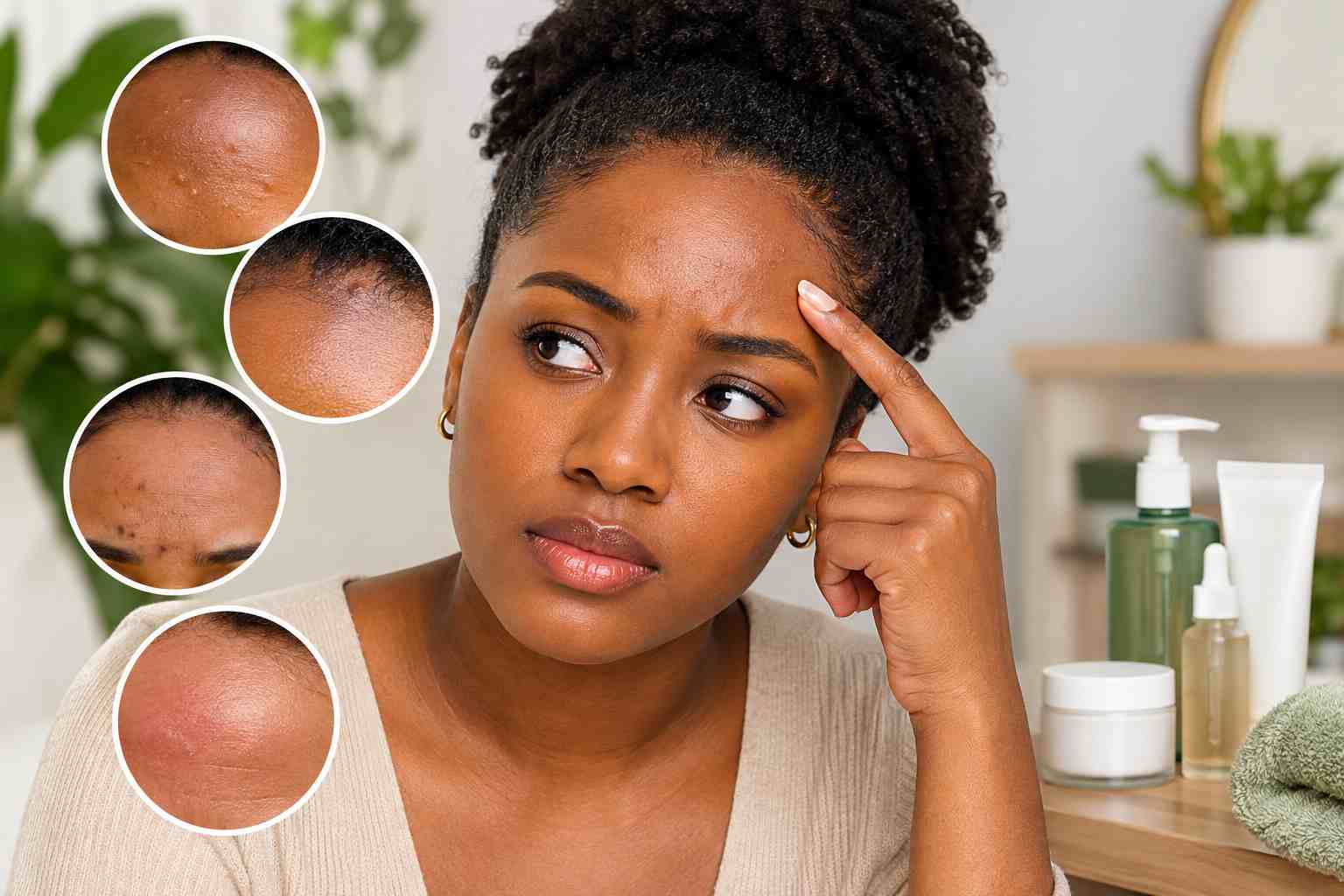
Have tiny bumps taken over your forehead, even though you keep trying new skincare products? Before buying another exfoliant or acne treatment, consider this: the bumps might be caused by clogged pores, your hair products, or inflammation around the hair follicles.
For people with melanin-rich skin, there is another reason to choose treatments carefully: inflammation and irritation can leave dark marks that remain long after the bumps improve.
The key is to identify the likely cause before treating it. Here is what may be behind your forehead bumps, which ingredients have evidence for treating acne, and when to seek professional advice.
1. What Do Tiny Bumps on Your Forehead Look Like?
The appearance of tiny bumps on your forehead can provide clues, but it cannot confirm the diagnosis.
- Small, skin-coloured or white bumps: These may be closed comedones, a type of acne caused by blocked hair follicles.
- Bumps concentrated around your hairline: Hair oils, pomades, and styling products may contribute to product-related acne.
- Similar-looking, itchy bumps: Folliculitis, which involves inflammation of hair follicles, is one possibility.
- Bumps accompanied by burning, tightness, or flaking: Irritation from skincare products may be contributing.
On melanin-rich skin, inflammation may look brown, purple, or darker than your usual skin tone rather than bright red.
These signs are clues, not a diagnosis. Acne, folliculitis, and irritation can look similar but may require different treatments.
2. What Causes Tiny Bumps on Your Forehead?
Understanding the cause of tiny bumps on your forehead can help you avoid unnecessary products and treatments.
Clogged pores and tiny bumps on your forehead
Oil and dead skin cells can accumulate inside hair follicles, forming closed comedones. These bumps often feel like small, uneven patches on the skin.
Some skincare and hair-care products can contribute to blocked pores. If the bumps appeared after introducing a new product, consider whether it could be a trigger. Products labelled non-comedogenic may be a useful choice, although no label guarantees that a product will suit everyone.
Hair products and tiny bumps on your forehead
Hair oils, pomades, conditioners, gels, and waxes can leave residue around the hairline. The American Academy of Dermatology identifies oils in hair-care products as a cause of small breakouts along the forehead and hairline.
If you suspect your hair products are responsible, keep them away from your forehead, rinse conditioner thoroughly, and wash pillowcases and headwear regularly. Give your skin time to respond after removing the suspected trigger.
Source: American Academy of Dermatology — Hair-care products and breakouts.
Sweat, friction, and tiny bumps on your forehead
Sweat, tight headwear, and repeated rubbing may aggravate some skin conditions, especially during exercise or in warm weather.
Gently cleanse after heavy sweating and avoid scrubbing your forehead. Sweat alone does not necessarily cause clogged pores.
Skincare irritation and tiny bumps on your forehead
Harsh cleansers, frequent exfoliation, and combining several active ingredients can irritate your skin. This may cause dryness, stinging, roughness, and inflammation.
For melanin-rich skin, controlling irritation is particularly important because inflammation can trigger post-inflammatory hyperpigmentation (PIH)—dark marks that remain after a skin injury, breakout, or inflammatory condition improves.
A clinical review of hyperpigmentation in skin of colour highlights the importance of controlling inflammation and protecting the skin from further irritation.
Source: Clinical review — Managing facial hyperpigmentation in skin of colour.
3. How Can You Help Tiny Bumps on Your Forehead?
The best approach to tiny bumps on your forehead depends on their cause. Start with a simple routine before adding treatment products.
Morning routine
- Cleanse gently. Use a mild cleanser that does not leave your skin feeling tight or stripped.
- Moisturise. Choose a moisturiser suitable for your skin. A non-comedogenic option may be helpful if clogged pores are a concern.
- Apply sunscreen. Choose broad-spectrum SPF 30 or higher. Regular sun protection helps reduce UV-related skin damage and can help prevent dark marks from becoming more noticeable.
For people concerned about hyperpigmentation, a tinted sunscreen containing iron oxides may offer additional protection against visible light. Choose a formula that suits your skin and that you can apply consistently.
Source: American Academy of Dermatology — How to fade dark spots in darker skin tones.
Evening routine
- Gently cleanse to remove sunscreen, sweat, and product residue.
- Apply a suitable moisturiser.
- If acne is likely, consider an appropriate acne treatment rather than combining several new ingredients at once.
If your skin is burning, stinging, or peeling, pause irritating products and allow your routine to become gentler. If the bumps are concentrated around your hairline, review your hair products before assuming you need an acne treatment.
4. Which Ingredients May Help Tiny Bumps on Your Forehead?
Not every ingredient used for acne will help every type of forehead bump. The following ingredients have evidence for treating acne, but the right choice depends on whether your bumps are actually acne-related.
Salicylic acid: for clogged pores and some types of acne
Salicylic acid helps loosen the buildup of dead skin cells and unclog pores. It may be useful for blackheads, whiteheads, and some mild acne.
However, the American Academy of Dermatology gives salicylic acid a conditional recommendation in its acne guidelines, meaning the evidence is more limited than for some other established acne treatments.
How to approach it: Start with one product and follow its instructions. Avoid combining it immediately with other exfoliating acids or retinoids, particularly if your skin is sensitive or already irritated.
Benzoyl peroxide: for inflammatory acne
Benzoyl peroxide helps reduce acne-causing bacteria and is an established treatment for inflammatory acne.
It is not a universal treatment for tiny bumps caused by hair products, folliculitis, or irritation.
How to approach it: A lower-strength product may be a reasonable starting point for some people with acne, but it can still cause dryness, irritation, and bleaching of fabrics. Stop using it and seek advice if you develop significant irritation.
Adapalene: for acne-related clogged pores
Adapalene is a topical retinoid that helps prevent blocked pores and treats several forms of acne, including blackheads and whiteheads. It may be suitable for persistent comedonal acne, but it is not the right first step for every unexplained forehead bump.
How to approach it: Introduce it cautiously and follow the product instructions. Dryness, peeling, and irritation can occur, and irritation may contribute to dark marks in melanin-rich skin. Avoid adapalene during pregnancy or when planning pregnancy; ask a healthcare professional about appropriate alternatives.
Azelaic acid: for acne and associated dark marks
Azelaic acid can help treat acne and may also improve post-inflammatory dark marks left after acne clears. This can make it a useful ingredient to discuss when both breakouts and uneven pigmentation are concerns.
However, it will not necessarily treat folliculitis or every other cause of forehead bumps, and it can still cause irritation.
How to approach it: Choose a suitable formulation and introduce it gradually. If you have persistent bumps or significant pigmentation, seek professional advice about the most appropriate treatment.
The American Academy of Dermatology’s acne guidelines recommend benzoyl peroxide and topical retinoids, while salicylic acid and azelaic acid receive conditional recommendations. These are evidence-based treatments for acne—not proof that any one ingredient will work for all forehead bumps.
Source: American Academy of Dermatology — Acne clinical guidelines.
Important: You do not need to use all these ingredients together. Start by identifying the likely cause, introduce one new treatment at a time, and stop if significant irritation develops. If you are pregnant or planning pregnancy, seek professional advice before choosing acne treatments. Explore our ingredients
5. Can Tiny Bumps on Your Forehead Leave Dark Marks?
Yes. Inflammation caused by acne, irritation, or skin injury can trigger post-inflammatory hyperpigmentation. These marks can be especially noticeable and persistent in people with darker skin tones.
To reduce the risk of dark marks:
- Avoid squeezing, scratching, or scraping the bumps.
- Treat the underlying condition rather than repeatedly exfoliating the skin.
- Introduce active ingredients gradually to minimise irritation.
- Use broad-spectrum sunscreen consistently.
- Seek advice if breakouts or pigmentation persist.
Sunscreen helps prevent UV-related darkening, but it does not replace treatment for the condition causing the bumps. For persistent pigmentation, a healthcare professional can help you choose an appropriate treatment.
Source: American Academy of Family Physicians — Dermatologic conditions in skin of colour.
6. How Long Do Tiny Bumps on Your Forehead Take to Improve?
The time needed for tiny bumps on your forehead to improve depends on the cause and whether the treatment is appropriate.
- Hair-product-related breakouts: The American Academy of Dermatology notes that clearing can take around four to six weeks after the responsible product is stopped.
- Acne-related clogged pores: Improvement often takes several weeks of consistent treatment. Some acne products may need six to eight weeks before their benefits become clear.
- Folliculitis or persistent irritation: These may need a different treatment, particularly if the cause is unclear.
Avoid changing products every few days because you do not see immediate results. However, do not push through significant burning, swelling, or worsening irritation in the hope that a product will eventually work.
7. When Should You Seek Help for Tiny Bumps on Your Forehead?
Seek advice from a qualified healthcare professional if your forehead bumps persist, become painful, are very itchy, spread quickly, produce pus, or leave scars or persistent dark marks.
Seek prompt medical attention if you develop severe pain, fever, rapidly spreading inflammation, or swelling around the eyes.
A professional can help distinguish acne from folliculitis, irritation, and other skin conditions before you spend money on treatments that may not address the cause.
8. Frequently Asked Questions About Tiny Bumps on Your Forehead
Are tiny bumps on your forehead always acne?
No. They may be clogged pores, product-related breakouts, folliculitis, or another skin condition. Their appearance alone cannot confirm the cause.
Can hair oil cause tiny bumps on your forehead?
Yes. Some hair-care products can contribute to breakouts around the forehead and hairline. Keeping suspected products away from the skin may help.
Should you scrub tiny bumps on your forehead away?
No. Scrubbing can increase irritation and inflammation. Gentle cleansing and an appropriate treatment are safer starting points.
How can you prevent dark marks after forehead bumps?
Avoid picking, minimise irritation, address the underlying skin condition, and use sunscreen consistently. If dark marks persist, seek professional advice before adding multiple pigmentation treatments.
9. A Smarter Approach to Tiny Bumps on Your Forehead
If you have tiny bumps on your forehead, begin by reviewing your hair and skincare products, simplifying your routine, and observing how your skin responds. Do not assume you need a stronger exfoliant or multiple acne treatments.
For melanin-rich skin, the goal is to address the underlying cause while reducing unnecessary inflammation that may leave dark marks.
Want help understanding your skin concerns and building a suitable routine? Explore the Melanin Theory Skin Assessment and our skincare education resources for melanin-rich skin.
Medical references
- American Academy of Dermatology. Are your hair-care products causing breakouts?
- Reynolds RV, et al. Guidelines of care for the management of acne vulgaris. Journal of the American Academy of Dermatology. 2024. Read the clinical guideline.
- Dermatology: How to manage facial hyperpigmentation in skin of colour. Read the clinical review.
- American Academy of Dermatology. How to fade dark spots in darker skin tones.
- American Academy of Dermatology. Is any acne treatment safe to use during pregnancy?.
Leave a Reply