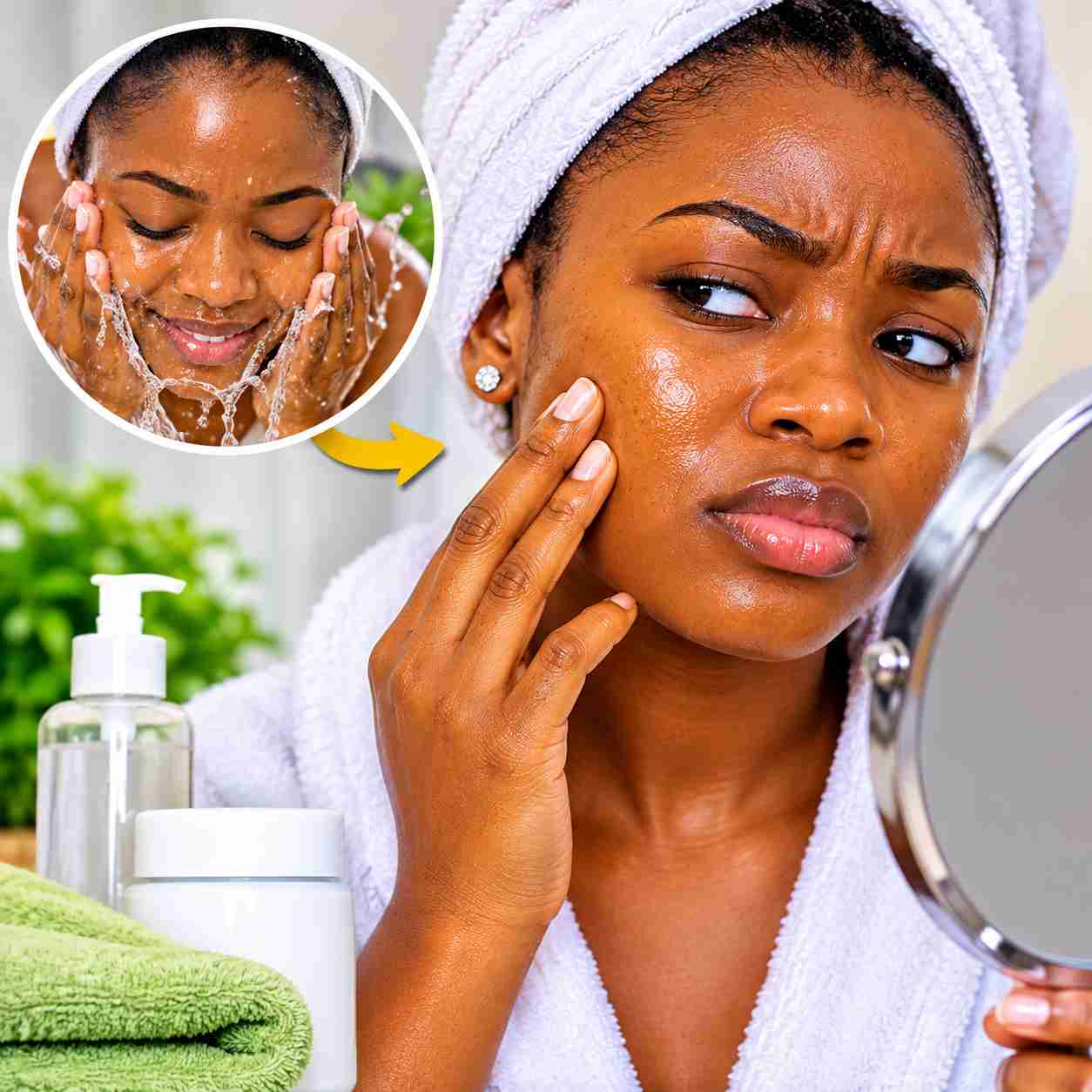
You wash your face, pat it dry and enjoy that clean feeling. But barely an hour or two later, your forehead and nose are shiny again.
Sound familiar?
If your face gets oily quickly after washing, your first instinct might be to wash it again or switch to a stronger cleanser. But that may not solve the problem.
Your skin naturally produces oil. The key is understanding why it becomes noticeable so quickly—and how to manage it without irritating your skin.
If you are still building your skincare foundation, our complete guide to skincare for melanin-rich skin in Kenya explains the fundamentals of caring for your skin and choosing products that support its needs.
1. Why does your face become oily again after washing?
Your skin contains tiny structures called sebaceous glands, which produce an oily substance known as sebum.
Sebum helps protect the skin surface and reduce moisture loss. It is a normal part of healthy skin function.
When you wash your face, you remove some of the oil sitting on the surface. However, your sebaceous glands continue producing sebum. As it reaches the skin surface, your face can become shiny again.
This is why washing your face does not permanently remove oiliness.
Sebum production is influenced by several factors, particularly genetics and hormones. Androgens, for example, stimulate sebaceous gland activity.
The important distinction: having oily skin is not automatically a sign that your skin is dirty or unhealthy. The goal is to manage excess shine while maintaining a healthy skin barrier.
Scientific reference: DermNet – Sebum.
2. Six reasons your face may get oily so quickly
1. Genetics
Your genes influence the size and activity of your sebaceous glands. Some people naturally produce more sebum than others.
If oily skin runs in your family, your skin may simply have a greater tendency to become shiny throughout the day.
2. Hormonal changes
Hormones can influence how much sebum your skin produces.
Oiliness may become more noticeable during puberty, around certain stages of the menstrual cycle, or during other hormonal changes.
This is one reason why your skin may not behave the same way throughout the month.
3. Using a cleanser that is too harsh
A cleanser that leaves your face feeling extremely tight, dry or uncomfortable may be too harsh for your skin.
Aggressive cleansing and scrubbing can irritate the skin. Some harsh products may also worsen oiliness rather than improve it.
Do not confuse the feeling of being completely stripped of oil with effective cleansing.
A good cleanser should remove dirt, sweat and excess surface oil without leaving your skin uncomfortable.
If you are unsure whether your products are being used in the right sequence, read our guide to applying skincare products in the correct order. A well-structured routine can help you avoid unnecessary steps and product overload.
Scientific reference: American Academy of Dermatology – How to Control Oily Skin.
4. Heat, humidity and sweating
Hot weather, physical activity and humid conditions can make your face feel increasingly greasy.
However, not all the moisture or shine you notice is sebum.
Sweat and sebum are different substances. Sweat comes from sweat glands, while sebum is produced by sebaceous glands. They can mix on the skin surface, making your face feel even greasier.
This may explain why your skin feels oilier on a hot afternoon than it does in the morning.
5. Skincare products that do not suit your skin
Some products may feel too heavy for your skin or contribute to clogged pores.
For oily or acne-prone skin, consider products labelled:
- Oil-free.
- Non-comedogenic.
- Won’t clog pores.
These labels can help guide your choices, although no product is guaranteed to suit everyone.
6. An overly complicated skincare routine
Using several exfoliating products, strong cleansers and acne treatments at the same time can irritate your skin.
More products do not necessarily mean better results.
If your face feels oily but also stings, becomes tight or starts peeling, consider whether your routine is too aggressive.
3. Is your skin naturally oily or becoming irritated?
Oily skin and irritated skin can sometimes occur together, but they are not the same thing.
Pay attention to the following differences:
| What you notice | What it may suggest |
|---|---|
| Shine across the forehead, nose and cheeks | Naturally oily skin |
| Shine mainly around the forehead and nose | Possible combination skin |
| Oiliness with blackheads or clogged pores | Oiliness alongside comedonal acne |
| Tightness, stinging or peeling after cleansing | Possible irritation or dryness |
| Burning, persistent redness or discomfort | Possible skin irritation requiring attention |
These signs are clues, not a diagnosis. Oily skin can also be sensitive, and acne cannot be diagnosed from shine alone.
If your face feels uncomfortable after washing, do not respond by cleansing more frequently. Reconsider the products you are using.
4. How to manage oily skin without damaging your skin barrier
You do not need to eliminate all your skin’s natural oil. Instead, focus on reducing excess shine, preventing clogged pores and keeping your skin comfortable.
Choose a gentle cleanser
Wash your face using a mild, non-abrasive cleanser.
Use lukewarm water and your fingertips rather than scrubbing with a rough washcloth or cleansing brush.
For most people, cleansing up to twice daily and after heavy sweating is sufficient.
Scientific reference: AAD – Face Washing 101.
Consider ingredients that address your actual concern
Not every skincare ingredient performs the same function.
Salicylic acid is a beta-hydroxy acid (BHA) that helps loosen the buildup of dead skin cells inside pores. It can be useful for people experiencing blackheads and clogged pores.
Start with a suitable, lower-strength product and introduce it gradually. Excessive use can cause dryness and irritation.
Niacinamide, a form of vitamin B3, supports the skin barrier and can help improve uneven skin tone. Some research also suggests it may help reduce visible oiliness.
It is a useful option to consider, particularly when your routine needs a gentle, multi-purpose ingredient. However, results vary.
Glycolic acid is an alpha-hydroxy acid (AHA) that exfoliates the skin surface. It may help improve uneven texture and the appearance of post-inflammatory marks.
It is not a primary oil-control ingredient, and frequent or excessive use can irritate the skin.
You do not need all three ingredients. Choose based on your main concern and introduce only one new active product at a time.
Before choosing an ingredient, it helps to understand what it actually does. You can explore the Melanin Theory Ingredient Library for more explanations of skincare ingredients, their functions and their suitability for different skin concerns.
Do not skip moisturiser
Having oily skin does not automatically mean your skin has enough water or does not need moisturising.
A lightweight, oil-free or non-comedogenic moisturiser may help maintain skin comfort, particularly if you use acne treatments or exfoliating ingredients.
Choose a texture that feels comfortable on your skin. You do not need a heavy cream if a lighter lotion or gel works better.
Wear sunscreen every morning
Sunscreen is important even when your main concern is oiliness.
Choose a broad-spectrum sunscreen with SPF 30 or higher. If you are prone to clogged pores, look for a formula labelled non-comedogenic.
For melanin-rich skin, protecting against UV exposure is particularly important when managing uneven pigmentation and dark marks.
A tinted sunscreen containing iron oxides may also provide additional protection against visible light, which can contribute to pigmentation in some people.
Scientific reference: American Academy of Family Physicians – Dermatologic Conditions in Skin of Color.
Use blotting papers when necessary
If your face becomes shiny during the day, blotting papers can absorb some surface oil without requiring another full face wash.
Gently press the paper against oily areas. Avoid rubbing it across your skin.
Remember: blotting papers temporarily remove surface oil; they do not reduce the amount your sebaceous glands produce.
5. A simple skincare routine for oily skin
You do not need a complicated routine to manage oily skin.
Morning
- Cleanse with a gentle face wash.
- Apply a suitable moisturiser.
- Finish with broad-spectrum SPF 30 or higher sunscreen.
Evening
- Cleanse to remove sunscreen, dirt and accumulated oil.
- Apply one suitable treatment ingredient if needed.
- Finish with moisturiser.
If you are new to active ingredients, begin slowly. Avoid introducing several exfoliating products at once.
Consistency and tolerability matter more than having a long product list.
6. Why this matters for melanin-rich skin
For people with melanin-rich skin, managing oily skin is not only about reducing shine.
Acne, irritation and other forms of skin inflammation can leave behind dark marks known as post-inflammatory hyperpigmentation (PIH).
This means that aggressive cleansing, picking at breakouts or using too many irritating products can create another problem while you are trying to solve the first one.
A better approach is to manage oiliness while protecting the skin barrier and avoiding unnecessary inflammation.
If dark marks are also a concern, understanding the role of your skin barrier is important. Our guide to repairing a damaged skin barrier explores why barrier care matters and how to avoid common skincare mistakes.
If you are unsure which skincare concerns or routine steps deserve your attention, the Melanin Theory Skin Assessment can help you explore a more personalised skincare approach.
If you are experiencing persistent acne, painful breakouts or dark marks that do not improve, a dermatologist can help identify an appropriate treatment.
Scientific reference: AAD – 10 Tips for Clearing Acne in Darker Skin Tones.
7. When should you seek professional advice?
Occasional shine is normal. However, consider speaking to a dermatologist or qualified healthcare professional if you experience:
- Persistent or worsening acne.
- Painful, deep or inflamed breakouts.
- Severe irritation, burning or peeling.
- A sudden and unusual change in oiliness, especially alongside other symptoms.
- Dark marks that continue to develop or cause concern.
A professional can help distinguish ordinary oily skin from acne, irritation or another underlying skin condition.
Frequently asked questions
Why does my face get oily one hour after washing?
Your sebaceous glands continue producing sebum after cleansing. If your skin naturally produces more oil, shine may return relatively quickly.
Should I wash my face whenever it becomes oily?
No. Repeated washing can irritate your skin. For most people, cleansing up to twice daily and after heavy sweating is sufficient. Use blotting papers if you need to manage shine between washes.
Does oily skin need moisturiser?
Yes, if your skin needs it. Choose a lightweight formula that suits your skin. Oil production and skin hydration are not the same thing.
Does drinking more water stop oily skin?
Drinking enough water supports general health, but there is no good evidence that simply drinking extra water switches off sebaceous gland activity or directly stops oily skin.
Can oily skin still have dark spots?
Yes. Oily skin can also experience acne and inflammation, which may leave post-inflammatory hyperpigmentation. Managing breakouts and avoiding irritation are important parts of preventing additional marks.
Final thoughts
If your face becomes oily shortly after washing, the answer is not necessarily a stronger cleanser or more frequent washing.
Your skin naturally produces sebum, and the amount varies between individuals.
Focus on gentle cleansing, suitable ingredients, lightweight moisturising and daily sun protection. Most importantly, avoid treating natural oil production as something your skin needs to eliminate completely.
Healthy skincare is about balance—not stripping your skin until it feels completely dry.
References
- American Academy of Dermatology. How to Control Oily Skin.
- American Academy of Dermatology. Face Washing 101.
- DermNet. Sebum.
- American Academy of Dermatology. 10 Tips for Clearing Acne in Darker Skin Tones.
- American Academy of Family Physicians. Dermatologic Conditions in Skin of Color.
Leave a Reply