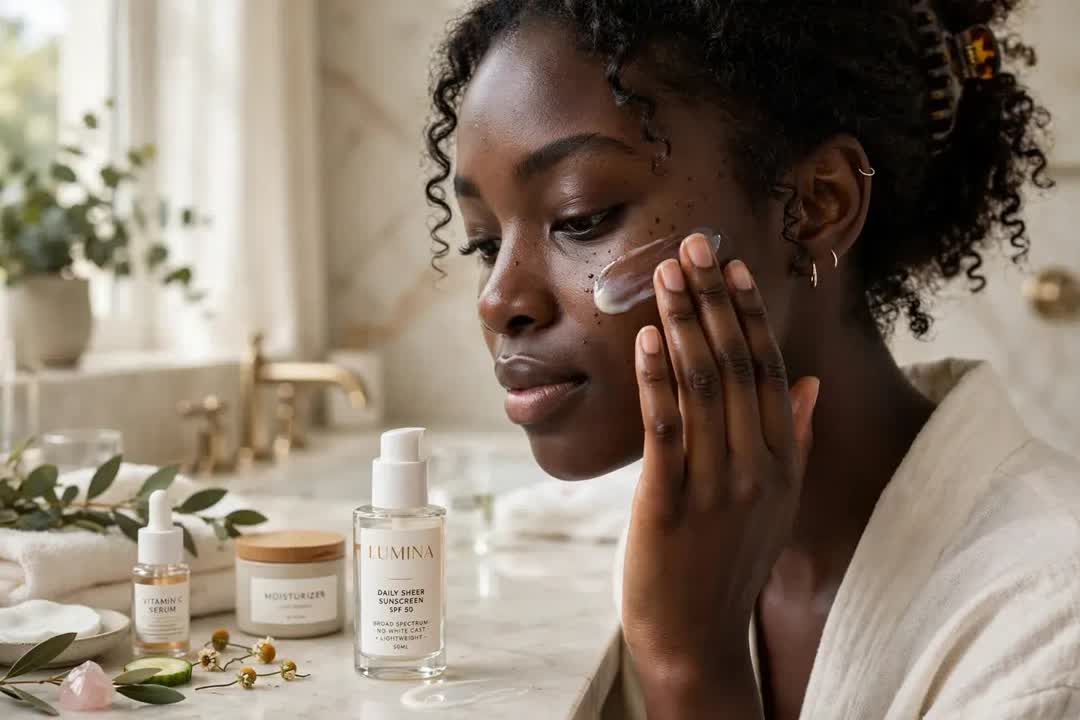
Your sunscreen is supposed to protect your skin—not leave you looking grey.
Yet many people with melanin-rich skin know the struggle. You apply your sunscreen, look in the mirror, and suddenly your complexion appears chalky, ashy, or purple-grey. Your skin may look completely different from how it looked before application.
This can be frustrating, especially when you are trying to protect your skin from sun damage and prevent dark spots.
Sometimes, the problem is not the way you apply sunscreen. It is the formulation itself. Certain sunscreens leave a visible residue on darker skin tones, while others blend in more naturally.
Unfortunately, this experience can lead people to use less sunscreen than recommended or stop using it altogether.
The good news? You do not have to choose between effective sun protection and a natural-looking finish. Understanding sunscreen ingredients, textures, and finishes can help you find an option that works better for your skin.
In this guide, we explain why white cast happens, what to look for when shopping for sunscreen in Kenya, and three products worth considering.
Why Does Sunscreen Leave a White Cast on Dark Skin?
A white cast is the visible white, grey, or sometimes purple-looking residue that remains on the skin after sunscreen application. It is particularly noticeable on deeper skin tones because the pale residue contrasts with the natural complexion.
One of the main causes is the sunscreen’s UV filters, particularly zinc oxide and titanium dioxide. However, the overall formulation—including particle size, coating, concentration, and the product’s base—also affects how the sunscreen looks on your skin.
1. Mineral sunscreens can leave a visible residue
Mineral sunscreens commonly use zinc oxide, titanium dioxide, or both to protect against ultraviolet radiation.
These ingredients are effective sunscreen filters, but they are naturally white powders. Depending on how they are formulated, they may leave a noticeable layer on the skin.
On darker complexions, this residue can appear as a white, ashy, or grey cast.
Not every mineral sunscreen causes this problem. Some use specially formulated particles, tinted pigments, or other technologies to improve how they blend into the skin. However, if you have struggled with several mineral sunscreens, their visible finish may be worth considering when choosing your next product.
2. Some chemical sunscreens blend in more easily
Chemical, or organic, sunscreens use UV filters that absorb ultraviolet radiation and release the energy through processes that reduce the radiation reaching the skin.
Examples of these filters include avobenzone, octocrylene, and other approved UV-filter ingredients.
Many chemical sunscreen formulations use lightweight fluids, gels, or lotions that blend in without leaving an obvious white residue. This makes them a useful option for people who want their natural skin tone to remain visible.
However, chemical sunscreens are not automatically invisible. Some can still leave a film, feel greasy, or appear shiny depending on their ingredients and formulation.
The important thing is to judge the finished product, not just whether the label says mineral or chemical.
3. The formulation matters as much as the ingredients
Two sunscreens can contain similar UV filters and still look very different on the skin.
One may spread evenly and dry down transparently, while another leaves a thick, pale film.
The texture, amount of product applied, how quickly it dries, and how it interacts with your moisturizer can all influence the final appearance.
This is why choosing sunscreen based only on its SPF number or a product’s popularity may not give you the result you want.
Why Sunscreen Matters for Melanin-Rich Skin
Melanin provides some natural protection against ultraviolet radiation, but it does not make darker skin immune to sun damage.
Sun exposure can contribute to uneven skin tone, premature skin aging, and worsening hyperpigmentation. It can also aggravate existing dark marks, including post-inflammatory hyperpigmentation—the dark spots that remain after acne, irritation, or other skin inflammation.You can learn more about Melanin-rich skin in our Melanin Explained: Understanding the Science behind Dark Skin
If you are investing in products to improve dark spots, sunscreen should be part of your routine. Without consistent sun protection, dark marks may persist for longer or become more noticeable.
This is especially relevant in Kenya, where strong sunlight and substantial UV exposure can occur throughout the year. Your actual exposure depends on factors such as the time of day, weather, altitude, and how much time you spend outdoors.
A sunscreen that feels comfortable and looks good on your skin is more likely to become a habit. The aim is not simply to find an invisible product; it is to find effective protection that you will apply in the recommended amount every day.
What Should You Look for When Buying Sunscreen in Kenya?
Before choosing your next sunscreen, pay attention to these five factors.
1. Choose broad-spectrum SPF 30 or higher
Look for a sunscreen labelled broad-spectrum SPF 30 or higher.
SPF primarily indicates protection against UVB radiation, which contributes to sunburn. Broad-spectrum labelling indicates that the product also protects against UVA radiation, which contributes to skin aging and pigmentation changes.
SPF 50 or 50+ can be a practical choice, especially when you spend considerable time outdoors. However, no sunscreen blocks every UV ray, and a higher SPF does not eliminate the need for proper application and reapplication.
2. Consider lightweight fluids, gels, and lotions
If you dislike a thick or chalky finish, try lightweight sunscreen fluids, gel-creams, or lotions.
These textures may spread more easily and feel less heavy, especially in warm weather. Some dry down with a natural finish, while others provide a dewy or matte appearance.
If your skin is oily, you may prefer a lightweight formula that does not leave a heavy, greasy feeling. If your skin is dry, a more moisturising lotion may be comfortable.
Remember that texture alone does not guarantee a white-cast-free finish. If possible, test a small amount on your face or jawline before committing to a full-size product.
3. Consider tinted sunscreens with iron oxides
Tinted sunscreens contain pigments that help the product blend with your skin tone. Some use iron oxides to create their tint.
These formulations can reduce the visible white cast associated with certain sunscreen filters. Iron oxides may also provide additional protection against some visible light, which can contribute to pigmentation in susceptible individuals, particularly those prone to persistent dark spots.
This is one reason tinted sunscreens may be worth considering if hyperpigmentation is a major concern.
However, the tint needs to match your complexion, and not every tinted sunscreen provides the same level of visible-light protection. Look for a suitable shade and a product with clear information about its intended protection.
4. Match the finish to your skin type
Your skin type can help narrow your options.
- Oily skin: Look for lightweight, non-greasy or shine-control formulations.
- Dry skin: Consider a more moisturising lotion or cream.
- Combination skin: A lightweight lotion or fluid may balance comfort across different areas of your face.
- Sensitive skin: Look for a well-tolerated, fragrance-free formula and patch-test before regular use.
These are starting points rather than strict rules. An oily skin type can still be sensitive, and a dry skin type can still experience breakouts.
5. Consider your budget and availability
A sunscreen does not have to be a luxury product to be useful. What matters is whether it offers appropriate protection, suits your skin, and fits your budget well enough for consistent use.
In Kenya, prices and stock can vary between pharmacies, supermarkets, beauty shops, and online sellers. Before buying, check the product name, SPF rating, expiry date, packaging, and seller reliability.
Avoid choosing a product solely because it is trending on social media. A popular sunscreen is not necessarily the right sunscreen for your skin.
3 Sunscreens to Consider for Dark Skin in Kenya
The following products are worth researching if you want to avoid the obvious white cast associated with some sunscreen formulations. They differ in texture and finish, so your preferred option will depend on your skin type, budget, and availability.
Product formulations can change between markets and over time. Check the current packaging and local product information before purchasing.
1. Garnier Super UV Invisible Sunscreen SPF 50+
Best to consider if you prefer: A lightweight sunscreen with a less noticeable finish.
Garnier Super UV Invisible Sunscreen is worth considering if you find thick creams uncomfortable or dislike the pale residue left by some sunscreens.
Its lightweight formulation is designed for everyday facial sun protection, making it a potential option for people who want sunscreen to sit comfortably under their normal skincare products.
A lighter texture can also make spreading sunscreen evenly easier. This matters because applying too little sunscreen reduces the protection you receive.
What to keep in mind: Garnier sells different sunscreen products across markets, and formulations can vary. Confirm that you are buying the intended invisible facial sunscreen, check the SPF and broad-spectrum information, and test how it blends into your complexion. Do not assume every product in the range will have the same finish.
2. NIVEA UV Face Shine Control SPF 50
Best to consider if you prefer: A less shiny finish, particularly if your skin becomes oily during the day.
If your face tends to look greasy shortly after applying skincare, a shine-control sunscreen may be more comfortable than a rich, dewy formula.
NIVEA UV Face Shine Control SPF 50 is designed for facial use with a focus on shine control. Its intended finish may appeal to people with oily or combination skin who want sun protection without adding too much visible shine.
However, a matte finish and a white-cast-free finish are not the same thing. A sunscreen can control shine and still leave a visible residue on some skin tones.
What to keep in mind: Check the precise version available in Kenya, since NIVEA products and formulations can differ between countries. If your skin is dry or sensitive, pay attention to how the formula feels after application.
3. Bioré UV Aqua Rich Watery Essence SPF 50+
Best to consider if you prefer: A lightweight, fluid texture that feels comfortable on the skin.
Bioré UV Aqua Rich Watery Essence is a Japanese sunscreen known for its lightweight, water-rich texture.
It may appeal to people who dislike heavy creams and prefer a sunscreen that spreads easily as part of a morning skincare routine. Its formulation is designed to provide a light, comfortable feel rather than the thick sensation associated with some traditional creams.
For people with melanin-rich skin, its texture makes it worth considering when searching for an alternative to sunscreens that leave a chalky finish.
What to keep in mind: A lightweight texture does not guarantee that every person will find the finish completely invisible. Check the current formulation, ingredient list, and label instructions, particularly if your skin is sensitive or reactive. Also consider the price and availability of authentic products in Kenya.
Which of the three should you choose?
There is no single sunscreen that is best for every person with dark skin.
If you dislike shine, start by exploring a shine-control formula. If you prefer a light, fluid texture, compare the Garnier and Bioré options. If possible, test your preferred product before buying a larger quantity.
The best option is the one that provides appropriate sun protection, suits your skin, and allows you to apply enough product comfortably and consistently.
How to Apply Sunscreen Without Compromising Protection
Finding a sunscreen you like is only half the job. Correct application is equally important.
Apply enough product
A common guide for the face is the two-finger method: squeeze two strips of sunscreen along your index and middle fingers. This can help you estimate a useful amount, although the exact amount required varies with finger size, face size, and the product.
Remember to cover your ears, neck, and other exposed areas. Follow the product label for application instructions.
Make sunscreen the last step of your skincare routine
In a typical morning routine, apply sunscreen after your moisturiser and before makeup.
Allow your skincare layers to settle as needed, then apply sunscreen evenly. Avoid mixing sunscreen directly into your moisturiser or foundation, because this can interfere with the tested formulation and reduce the protection you receive.
If you want to change the appearance of sunscreen, choose a tinted product formulated for that purpose rather than altering the sunscreen yourself.
Reapply when necessary
Reapply at least every two hours when outdoors, and reapply after swimming, sweating, or towel-drying according to the product label.
If you spend most of your day indoors, your exposure will depend on your activities, including time near windows and whether you go outside. Reapplication is especially important during prolonged outdoor exposure.
You can also support your sun protection with shade, a hat, and protective clothing.
Give a new formula a fair test
When trying a sunscreen for the first time, apply it as directed and observe how it looks after it has settled.
Check whether it leaves a cast, feels comfortable, pills over your moisturiser, or causes irritation. A product that looks clear immediately may dry differently after several minutes.
If a sunscreen consistently irritates your skin, stop using it and consider a different formulation.
Common Sunscreen Mistakes to Avoid
Even a good sunscreen may not deliver the expected results if it is used incorrectly.
- Applying too little: A thin layer may provide less protection than the SPF on the label suggests.
- Choosing only by SPF: SPF matters, but broad-spectrum protection, comfort, formulation, and consistent use matter too.
- Skipping sunscreen because of dark skin: Melanin offers some natural protection, not complete protection from UV damage.
- Mixing sunscreen with other products: This can interfere with the sunscreen’s tested performance.
- Ignoring the expiry date: Expired or poorly stored sunscreen may not provide the expected protection.
- Assuming every expensive product is better: Price alone does not determine how well a sunscreen suits your skin.
The Bottom Line: You Can Protect Your Skin Without Hiding Your Complexion
A white cast can make sunscreen frustrating, especially when you have spent time and money building a skincare routine that works for your complexion.
But you do not need to give up sun protection.
Start by looking for a broad-spectrum sunscreen with SPF 30 or higher. Explore lightweight formulations if you prefer a less noticeable finish, or consider a tinted sunscreen with iron oxides if you are also concerned about hyperpigmentation.
Garnier Super UV Invisible Sunscreen, NIVEA UV Face Shine Control, and Bioré UV Aqua Rich Watery Essence are three options worth exploring. Compare the versions available locally, check their labels, and choose the one that suits your skin and budget.
At Melanin Theory, we believe skincare should be practical, evidence-based, and relevant to the realities of melanin-rich skin in Africa. You deserve advice that helps you make informed decisions—not pressure to buy every trending product.
Not sure which skincare products suit your skin type and concerns? Take the Melanin Theory Skin Assessment Quiz to help you understand your skin profile and build a more suitable routine.
References
- American Academy of Dermatology Association. How to decode a sunscreen label.
- American Academy of Dermatology Association. How to select a sunscreen.
- American Academy of Dermatology Association. Guidance on sunscreen application and sun protection.
Leave a Reply